
220kg
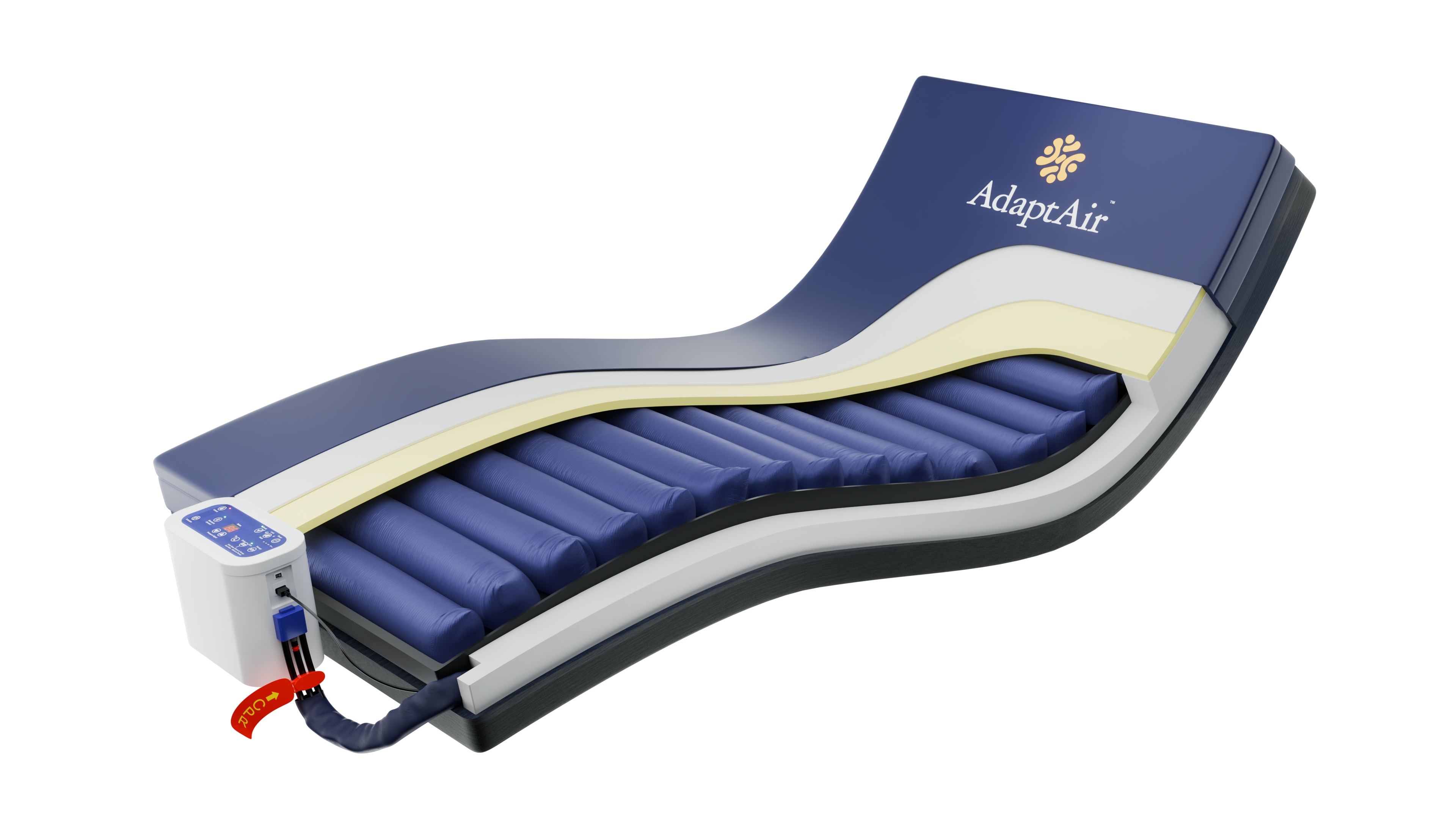
The AdaptAir Pro™ Air Mattress System — an innovative, fully adaptive air mattress system designed for individualised care. Effortlessly switch between foam and alternating air with enhanced envelopment, live pressure management, and remote monitoring. Supports pressure redistribution, postural stability, and customised comfort for diverse clinical needs.
▶Watch it in actionSpecifications & funding report dataWarranty, ISO, ARTG, service life and lead times — everything for your report↓From the manufacturer
The strongest argument for AdaptAir is not any single therapy mode — it is that the platform can be reconfigured without being replaced. Pressure care prescription normally works against you here. A client's risk changes: a wound heals, or a new one appears, or their mobility drops, or their tolerance for alternation changes. Each change usually means a new application, a new hire period, and a gap in which the client is on the wrong surface. AdaptAir runs six systems on one platform — Full Air, Full Air Comfort, Hybrid Air and Full Foam, with 1-in-2 or 1-in-3 alternation cycles — and switches between them on the spot. In a funding submission, "this asset stays appropriate through a change of circumstance" is a genuinely strong case, and it is worth making explicitly rather than describing the therapy modes alone. The configurations, briefly: Full Air uses 18 detachable full-length cells for whole-body on-load/off-load cycling, aimed at the sacrum and heels. Full Air Comfort puts a foam or comfort layer over those 18 cells for thermal regulation and tolerance. Hybrid Air embeds 8 detachable cells in a foam core for gentler immersion with postural support. Full Foam is a static surface with adaptive redistribution. All configurations carry a low-shear inner layer and a breathable 4-way stretch PU outer with welded seams. Bottoming out is the failure mode that matters. When a client's sacrum contacts the base through a deflated cell, they receive full, unrelieved pressure at exactly the site the mattress was prescribed to protect — and on most systems nobody knows it is happening. AdaptAir addresses it three ways: a sacrum-fed air line, an air injection method designed to prevent it, and a tilt sensor. The NE7 pump reports live mmHg surface readings, so it is measurable rather than assumed. Remote and wireless monitoring gives real-time pressure analytics and SMS alerts for system errors, power loss, leaks, pressure changes and variations in patient behaviour. That closes the loop on the other common community failure — a pump switched off or misconfigured with nobody aware. Two practical points at assessment. Working weight is 30–220 kg, and the lower bound matters: an alternating system needs enough load to compress its cells, and a client under 30 kg will effectively sit on top of the surface rather than in it. Second, static Transfer (60 min) and Care (20 min) modes firm the surface for transfers and on-bed personal care — an alternating surface is genuinely unstable to work on, and this is a manual-handling safeguard as much as a convenience. The foam is Hygroflex. Studio Care cite RMIT University (2018) testing showing envelopment improved by up to 30% over traditional memory foams, peak interface pressure reduced by 32%, 50% easier to roll, and 27% better heat dissipation. Detachable cells allow targeted offloading or replacement, foam inserts can intensify support in specific zones, solid foam sidewalls protect during repositioning, and a CPR valve is fitted. Pairing with a TheraCloud control unit unlocks full immersion therapy through mmHg-specific cell manipulation. A battery backup add-on is available. Australian made.
We aim to make our range as accessible as possible. Some products may not be available in all areas — please contact BMS Plus to confirm availability and discuss suitable options.
Product detail

Everything needed to justify this equipment in an NDIS, DVA or Home Care Package report.