
200kg
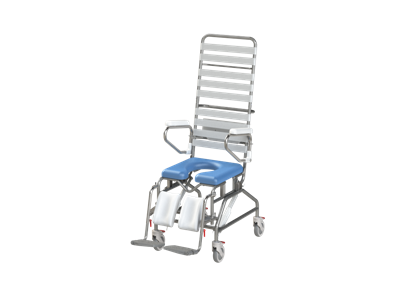
Available in Electric or Manual Tilt Available in 400, 445, 500, 550 and 600mm seat widths . Independently tested to conform to AS/NZS 3973:2009 for safety and peace of mind . Extra high PVC strap backrest for improved comfort and safety . 10-35° tilt angle . Integrated push-handle for manoeuvrability . Swing-up padded arms for unrestricted side transfer . Swingaway and removable height adjustable footrest with contoured padded calf supports . 4x 125mm total locking castors . Designed to be used with a K Care patented removable seats .
▶Watch it in actionSpecifications & funding report dataWarranty, ISO, ARTG, service life and lead times — everything for your report↓From the manufacturer
This unit combines three things that are usually specified separately — a shower commode, a transit chair and a tilting seating system — and each one narrows who it suits. Tilt is the clinical core, and the published range here is 10–35 degrees. That upper figure matters: meaningful offloading of the ischial tuberosities generally requires tilt beyond roughly 25–30 degrees, and a lot of "tilting" commodes stop short of it. At 35 degrees this one reaches into the range where the tilt is doing real pressure work rather than just stopping the client sliding forward. Both effects are useful. A client who cannot hold an upright seated posture through a shower will slide forward, and sliding forward on a commode aperture is both a fall risk and a shear event across the sacrum. Tilting the whole seating unit backwards uses gravity to hold the client against the backrest instead of asking them to hold themselves there. It also allows load to be shifted during longer sessions — relevant because prolonged sitting on a commode aperture concentrates pressure into a narrow band of tissue at the rim of the opening, which is a recognised and often overlooked pressure risk during bowel care. K Care offer the tilt in either electric or manual form. Electric lets a single carer adjust position without stopping and repositioning their hands, which matters in a wet environment; manual is simpler and has nothing to charge. Choose on the basis of who will be operating it and how often, not on cost alone. "Transit" means the chair is rated to move the client between rooms rather than only within the bathroom — so bedroom to bathroom and back can be a single seated journey with no intermediate transfer. Each transfer eliminated is a fall risk and a carer manual-handling event removed. An integrated push handle and four 125 mm total-locking castors support that, and the swing-up padded arms clear the way for an unrestricted side transfer. Seat widths are available at 400, 445, 500, 550 and 600 mm. Get this measurement right: a commode seat that is too wide lets the pelvis drift laterally and lose a stable base, while one that is too narrow creates pressure at the greater trochanters against the arms. K Care state the chair has been independently tested to AS/NZS 3973:2009. Capacity is 200 kg. Footrests are swing-away, removable and height-adjustable with contoured padded calf supports, and the backrest is an extra-high PVC strap design.
We aim to make our range as accessible as possible. Some products may not be available in all areas — please contact BMS Plus to confirm availability and discuss suitable options.
Product detail
Everything needed to justify this equipment in an NDIS, DVA or Home Care Package report.