
300kg
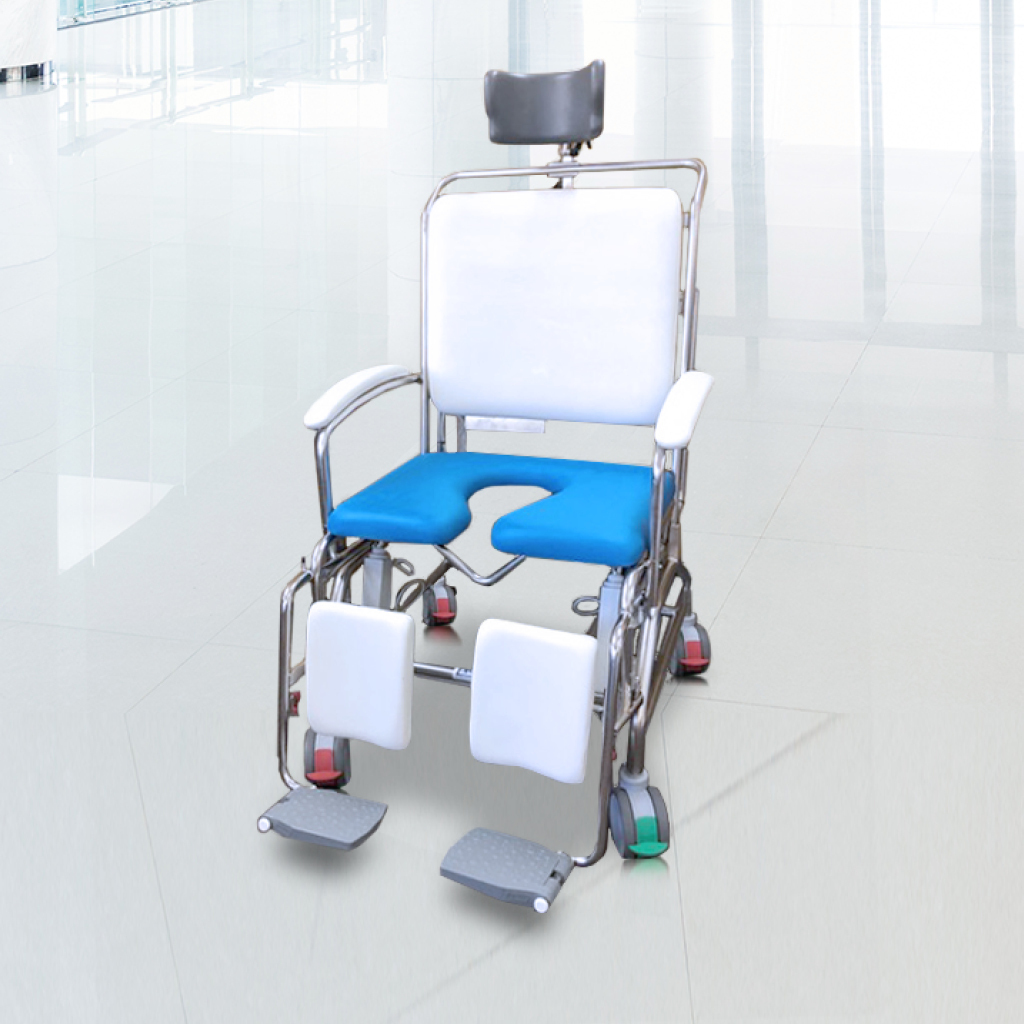
Independently tested to conform to AS/NZS 3973:2009 for safety and peace of mind . Dual electric actuator tilt mechanism . Contoured adjustable clamp on headrest . Curved vinly covered padded backrest . Integrated push-handle for manoeuvrability . Curved removable padded armrests . Swingaway and removable height adjustable footrest with contoured padded calf supports . 3x 125mm total locking twin castors 1x 125mm directional locking twin castor . Designed to be used with a K Care patented removable seats . Available in 600 and 650mm seat widths .
▶Watch it in actionSpecifications & funding report dataWarranty, ISO, ARTG, service life and lead times — everything for your report↓From the manufacturer
Bariatric shower commodes fail in specific ways, and the two that matter most are both dimensional rather than structural. The first is the aperture. On a bariatric client, a standard commode opening is proportionally too small — tissue occludes it, hygiene access is compromised, and the rim of the opening ends up loading soft tissue directly. Prolonged sitting on an aperture rim concentrates pressure into a narrow band around the perirectal and ischial area, which is a recognised and frequently overlooked pressure risk during bowel care. Check the aperture size against the client, not just the seat width. The second is overall width against the bathroom. Every millimetre of seat width becomes overall width, and overall width decides whether the chair passes the bathroom door and turns once inside. Measure the narrowest doorway and the turning space first, and let that set the ceiling — a chair the client fits but the room does not is the standard bariatric failure. Tilt-in-space is the clinical core. A client who cannot hold an upright seated posture through a shower slides forward, which is both a fall risk and a shear event across the sacrum. Tilting the whole seating unit uses gravity to hold them back against the backrest instead of requiring them to hold themselves there, and it allows load to be shifted during a long session. K Care specify dual electric actuation here, which matters at bariatric weights — manual tilt against that mass is not a one-carer task. K Care state the chair is independently tested to AS/NZS 3973:2009. One further check that is often missed: the bathroom floor and any floor waste grate have their own load limits, and the combined client-plus-chair weight has to clear them. So does the ramp or threshold on the way in.
We aim to make our range as accessible as possible. Some products may not be available in all areas — please contact BMS Plus to confirm availability and discuss suitable options.
Product detail
Everything needed to justify this equipment in an NDIS, DVA or Home Care Package report.